How Clay Runs High-Performance Lifecycle Marketing with Inflection
Clay wanted to turn their fast growing PLG motion into a stable engine for activation, habit formation, and product expansion. As a platform that enriches data, automates research, and helps GTM teams find their ideal customers, Clay attracts a wide mix of users across RevOps, marketing, and sales. Each persona brings different behaviors, use cases, and levels of readiness to buy. Clay’s marketing team had the data to understand these users, but they lacked a system to translate that insight into timely, personalized communication at scale.
With Inflection, Clay built lifecycle programs that increased activation by bringing more than 28% users back into the product.
The Challenge
Clay’s lifecycle team faced the classic PLG problem. While large numbers of users signed up, their paths through the product varied widely. Some became active immediately. Others explored one or two features and disappeared. New feature launches required ongoing education, yet the team had no reliable way to deliver targeted messages without creating dozens of one off campaigns. Even the most valuable data signals stayed trapped inside internal systems because there was no marketing automation platform to operationalize them across lifecycle communication.
The result was uneven onboarding, inconsistent activation, and missed opportunities to guide users toward the parts of Clay that mattered most for their role.
How Clay Used Inflection
Clay’s first Inflection powered lifecycle marketing campaign was the Week in Review email. The team used Inflection to insert a user’s activity inside Clay in the email. It read like a useful weekly snapshot of what the user had accomplished inside Clay and went viral on LinkedIn. It earned strong engagement, sparked social sharing, and proved that data driven, behavior triggered communication could outperform traditional lifecycle messaging.
With that foundation in place, Clay expanded the same data activated approach across the rest of the lifecycle.
Personalized Onboarding Tied To ICP
Clay applied the same principle of behavior based campaigns to the first touchpoint of the user journey. When a user signed up, Clay enriched their website to identify their ICP, and personalize communications based on that signal.
For example, a user targeting e-commerce sellers receives an onboarding email led with their specific challenge: knowing which signups will become best customers when they come in from many different sources. The email also shows how Clay could surface the most active buyers in ecommerce communities, pull a filtered list of Amazon and Walmart sellers by category and sales volume, and get decision-maker contacts for direct outreach.
This ICP signal then triggers a hyper personalized onboarding email from Inflection that frames Clay’s value around the user’s target customer. Instead of a single generic welcome, each new user received a version crafted specifically for the type of businesses they sell to.
This increased message relevance and drove a measurable lift in product logins by more than 28%. The onboarding motion reinforced the same insight gained from reactivation: personalization is only scalable when it is driven by data already available inside the product.
Reactivation As The Core Lifecycle Lever
Clay’s biggest gap was users who signed up, explored briefly, and never returned. The team used Inflection to detect inactivity at the 30, 60, and 90 day marks and send benchmark driven emails that showed how active customers were using Clay. The message was simple: here is what other teams like yours achieve with the product. This shifted the communication from a generic reminder to a personalized proof of value. It became the turning point of Clay’s lifecycle motion, consistently bringing back more than a hundred users each month and prompting each returning user to create at least one Clay table.
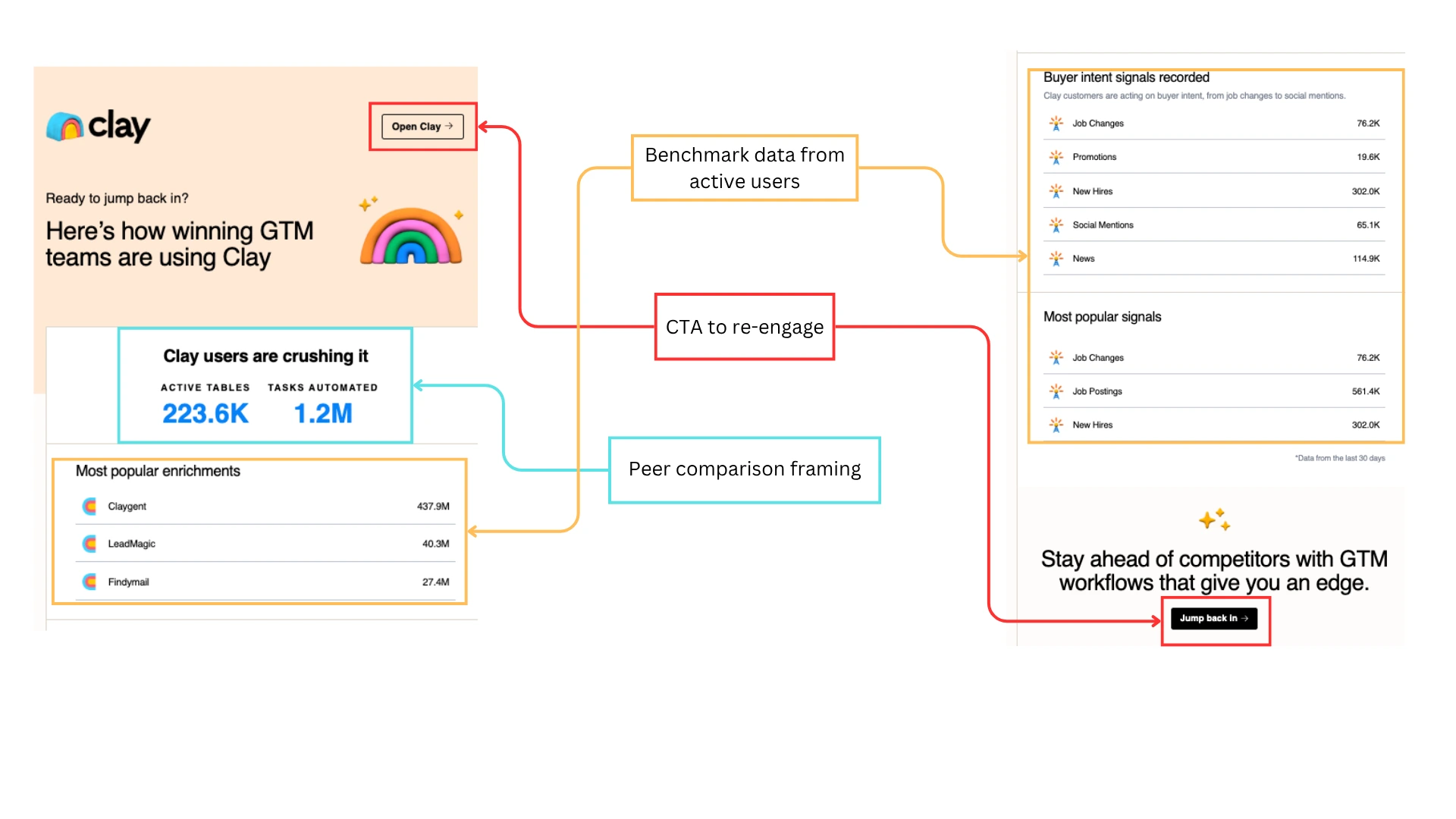 This reactivation program showed Clay what was possible when lifecycle communication was driven by real product data rather than static nurture sequences. With one strong motion in place, the team expanded the same operational model to the rest of the user journey.
Social Intent Signals That Triggered Relevant Education
Finally, Clay extended lifecycle orchestration beyond product data by incorporating external intent signals. The team used Clay to monitor when users mentioned specific pain points on LinkedIn that tied to features they had not yet adopted. Using Inflection the team triggered instantly with contextual product education from Clay’s Growth Strategist team.
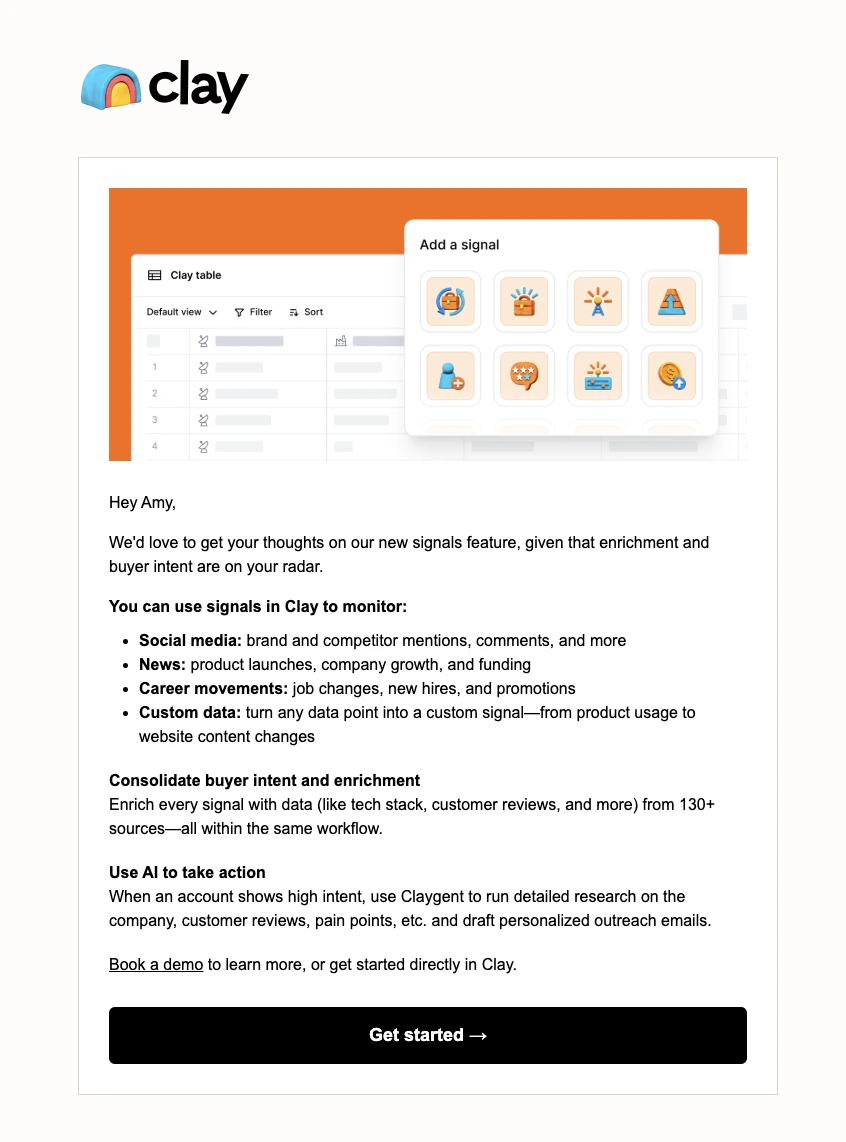 These messages succeeded because they reached users while the problem was already top of mind, creating a level of timing precision that would not be possible with scheduled campaigns. This completed the lifecycle system by tying together product behavior, onboarding context, ongoing engagement, and external intent.
Why It Worked
“Inflection turns our product data into a lifecycle engine. It helps us trigger the right message based on behavior, ICP context, and intent data, synced from Clay. It’s made personalizing our marketing campaigns truly scalable.”
Clay already had strong data about who its users were, what they were doing in the product, and when they were getting stuck. The gap was activation. Inflection made that data usable by turning product behavior, ICP attributes, inactivity windows, and public social mentions into e-mails that reached the right person, at the right time. Instead of scheduled nurtures or broad segments, Clay delivered emails at the moment a user showed intent, dropped off, or demonstrated a relevant need.
Clay moved from static lifecycle communication to dynamic orchestration built entirely on data and timing.
The Outcome
Clay’s lifecycle results were more than a series of isolated wins. The shift came from creating a lifecycle engine where data, timing, and message relevance worked together, producing measurable gains at every critical moment in the user journey.
The biggest change was in product usage. Increasing product logins by more than 28% in the number of users who actually reached value after signup. For a PLG product, that is the difference between a growing user base and a leaking funnel. Inflection made onboarding conversion predictable by tying communication to real ICP context rather than a static drip campaign.
Clay’s users received messages that reflected what they were doing — or not doing — in the product. That precision is why the lifecycle campaigns delivered more than double the usual engagement. Reactivation stopped being guesswork.
What changed for Clay was not a single campaign. It was the ability to turn its existing product and enrichment data into a lifecycle marketing engine.
TL;DR
Clay's lifecycle team used Inflection to turn a fragmented PLG motion into a data-driven engine that reached users at every critical moment — from first signup to reactivation. By connecting product behavior, ICP enrichment, and external intent signals to automated lifecycle campaigns, Clay moved from generic nurtures to personalized communication that consistently drove action. The result: a 28% lift in product logins, more than a hundred lapsed users brought back each month, and a lifecycle system that scales without manual effort.
See how Inflection can power the same outcome for your team. Request a demo.