Choosing The Best Enterprise Marketing Automation in 2026
At the enterprise level, marketing teams operate across large databases, multiple products, complex GTM motions, and tightly coupled revenue systems. Marketing automation is not just a campaign engine. It is infrastructure that affects how marketing works day to day and how it connects to sales, product, and customer success.
This is why enterprise teams often reassess their marketing automation platforms and begin evaluating Marketo alternatives, even when an existing tool technically “works”.
Why Enterprise Marketing Automation Decisions Are Different
Startups and smaller teams often choose marketing automation based on speed, simplicity, and basic functionality. Enterprise teams face a different set of constraints.
They must support:
Millions of contacts and thousands of accounts
Multiple acquisition, expansion, and retention motions often for multiple products running in parallel
Global teams with shared governance
Deep integration with CRM, data warehouses, and analytics tools
Increasing pressure to prove revenue impact beyond lead volume
These constraints change how enterprise teams should evaluate marketing automation. The question is no longer which platform has the most features, but which one is designed to operate under modern enterprise realities. That is why enterprise buyers tend to compare platforms across a consistent set of criteria tied to scale, data flexibility, operational efficiency, and long-term cost.
Enterprise Marketing Automation Comparison: Inflection vs Marketo vs Eloqua
Below is how Inflection, Marketo, and Eloqua compare across the dimensions that matter most at enterprise scale.
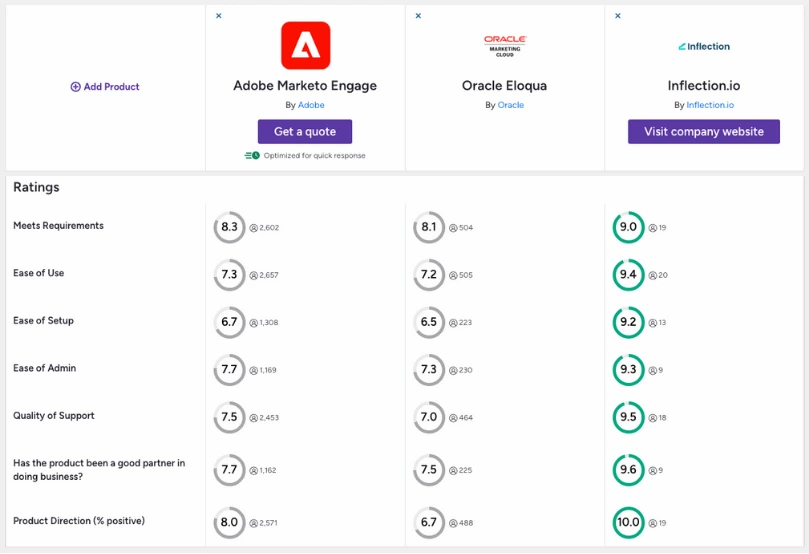
Target Audience and Enterprise Fit
Inflection
Inflection is built for modern enterprise teams that use product usage, behavioral signals, and lifecycle data to drive growth. It is particularly well suited for enterprises focused on expansion, cross-sell, and retention beyond acquisition.
Marketo
Marketo is widely adopted by enterprise B2B marketing teams, particularly those running traditional demand generation programs. It is often used by organizations with established marketing operations functions and mature lead management processes.
Eloqua
Eloqua is designed for large, centralized enterprise marketing organizations with complex governance, compliance, and global execution requirements. It is most commonly used in highly structured environments where control and consistency are prioritized.
Integration and Ecosystem Fit
Inflection
Inflection is built to work natively with CRM, data warehouses, and product analytics platforms, allowing marketing to operate as part of a unified revenue system. Behavioral and product data can flow directly into marketing workflows without heavy middleware or manual reconciliation.
Marketo
Marketo integrates broadly across CRM and sales tools, but deeper integration with product analytics and modern data platforms often requires additional middleware and ongoing maintenance.
Eloqua
Eloqua supports enterprise integrations, but these are typically managed through more rigid and technical configurations, making data flows harder to adapt as GTM requirements evolve.
Ease of Use and Operational Overhead
Inflection
Inflection is designed to reduce operational friction by making behavioral data and automation native to the platform. Marketing teams can build, launch, and iterate on campaigns without relying on engineering resources to access or transform product activity data. This allows teams to move faster, respond to real usage signals, and operate independently while still working with enterprise-grade data at scale.
Marketo
Enterprises that use Marketo rely heavily on marketing operations specialists to manage day-to-day execution. As programs grow more complex, operational overhead increases.
Eloqua
Eloqua is highly configurable but often requires dedicated and specialized administrators. This can slow iteration and limit how quickly teams respond to changes in buyer behavior or product usage.
Pricing and Scalability
Inflection
Inflection’s pricing is built around Monthly Marketed Contacts (MMCs), which counts the unique contacts that actively go through a marketing journey each month rather than the total size of an enterprise database. This means enterprises are not charged simply for storing large volumes of dormant leads or product users. MMC-based pricing aligns marketing automation cost with value delivered because teams only pay for contacts they are actively engaging, not the entire contact repository. This makes it more predictable when usage grows across lifecycle programs, expansion motions, and long-term retention campaigns, and helps enterprises scale without paying disproportionately for unused data.
Marketo
Marketo pricing scales largely with database size and usage. As enterprise datasets grow, costs increase regardless of how many contacts are actively marketed to. Over time, many enterprises end up spending heavily on maintaining large databases, making long-term cost predictability difficult as lifecycle and retention programs expand.
Eloqua
Eloqua is positioned at the high end of enterprise pricing, and costs tend to rise quickly with both scale and complexity. In large deployments, a significant portion of spend often goes toward storing and managing extensive contact databases rather than driving incremental marketing impact.
Innovation and Future Readiness
Inflection
Inflection is built as an AI-native marketing automation platform, with AI as a foundational capability rather than a cosmetic add-on.
AI in Inflection is foundational, not just a cosmetic add-on. The platform is built around a ContextGraphTM that unifies product activity, account data, lifecycle stage, and engagement signals into a single source of context. Inflection’s MCP server makes this context consistently available across campaigns and workflows, allowing AI to inform who to engage, when to engage, and how to prioritize based on real signals rather than static rules. This architecture supports advanced AI-driven use cases without requiring teams to rework their data model or marketing operations.
Marketo
Marketo evolves only within a lead-centric framework that was designed for an earlier phase of enterprise marketing. While new capabilities are added over time, innovation tends to layer onto existing architecture rather than rethinking it. As a result, enterprise teams often find it slower to adapt Marketo to modern, behavior-driven and product-informed GTM strategies.
Eloqua
Eloqua remains focused on serving large, centralized enterprise marketing organizations with complex orchestration needs. However, its underlying architecture has changed little over time. This limits the pace at which the platform can adapt to modern data models, AI-driven workflows, and the flexibility enterprise teams increasingly require.
What This Means for Enterprise Marketing Leaders
Marketo and Eloqua were built for an era when enterprise marketing was primarily lead-driven and campaign-centric. They continue to serve that model.
Inflection supports a shift toward enterprise marketing that is lifecycle-driven, product-informed, and tightly connected to revenue outcomes.
For enterprise marketing leaders, the right choice depends on how marketing is expected to drive growth. Teams focused primarily on traditional demand generation may continue to find value in established platforms. Teams responsible for expansion, customer engagement, and product-led growth increasingly need systems designed for those realities.
At the enterprise level, marketing automation is not just a tooling decision. It is a decision about how marketing operates, how it scales, and how directly it contributes to long-term growth.
Request a demo to see how Inflection supports modern enterprise GTM teams in practice.