
%201.webp)

Marketing in the Agentic Era: How B2B Teams Build Competitive Advantage With AI
AI is fundamentally reshaping how B2B companies compete, but not in the way most teams expected.
As large language models become widely accessible and are trained on the same publicly available data, their core capabilities are starting to converge. That means the model itself is no longer a durable source of advantage. At the same time, AI is making it significantly easier to build and replicate software, weakening traditional feature moats. In this environment, competitive advantage is shifting toward what cannot be easily copied: proprietary first-party data, real-time customer context, and the ability to turn that context into intelligent action.
This is why brand and customer relationships are becoming more important, not less. As features commoditize, growth and retention increasingly depend on delivering better, more relevant experiences across the lifecycle.
The companies that win in the agentic era will not be the ones with access to better models. They will be the ones that build systems around those models, systems that unify data across product, sales, marketing, and web touchpoints, continuously update customer context, and enable agents to act on that context in real time. This is what turns AI from a productivity tool into a system for increasing revenue, improving marketing intelligence, and operating faster at lower cost.
The End of AI as a Feature Advantage
The first wave of AI adoption in B2B marketing was largely focused on point solutions, content generation, lead scoring, campaign analysis, and sales assistance. These use cases delivered efficiency gains, but they did not fundamentally change how go-to-market systems operate.
The limitation is structural. When AI is layered on top of fragmented systems and static workflows, it inherits their constraints. It may accelerate execution, but it does not improve decision-making or coordination.
As models converge, this approach becomes even less effective. If every team is using similar AI capabilities on top of similar systems, the outputs will inevitably look the same. Feature differentiation erodes, and the speed of execution alone is no longer enough to win.
The next phase of AI in marketing is not about adding more features. It is about building better systems.
Where Competitive Advantage Now Comes From
Proprietary data is the foundation of competitive advantage in the agentic era. Unlike public data, it captures how customers actually use your product, engage with your brand, and move through the lifecycle. When unified across product, sales, marketing, and web systems, it becomes a differentiated input that generic AI cannot replicate.
But data alone is not enough, it needs to be activated. Most traditional systems are built for static workflows and batch execution, not for interpreting context or responding in real time. As a result, insights stay disconnected from action.
The shift is toward systems that continuously ingest signals, reason over evolving context, and trigger actions dynamically. This is what turns AI from a productivity layer into a system of execution.
.webp)
1. Modern data architecture
Competitive advantage starts with data that no one else has.Not just CRM records. Not just campaign engagement. The advantage comes from unifying product data, sales activity, marketing signals, web behavior, and customer context into a system that is continuously updated and usable in real time.This is what gives AI something differentiated to reason over. When your data architecture brings together zero-ETL connections across product, sales, marketing, and web data, supported by stream processing and a system that keeps customer context fresh, you create a proprietary intelligence layer that generic AI tools cannot replicate.In that world, the value is not the model by itself. The value is the unique dataset the model can access and interpret.
2. Open agentic architecture
If private data is the raw material for competitive advantage, agentic architecture is the system that turns that data into action. Most marketing automation platforms were built for fixed workflows, static segmentation, and batch campaigns. They can automate repetition, but they are not designed to support intelligent agents that reason across systems, coordinate decisions, and activate in the moment. An open agentic architecture changes that. With an open architecture and MCP-style connectivity, teams can enable agents to access the right context, orchestrate across tools, and trigger actions across the customer lifecycle. Instead of forcing teams into one closed workflow model, open agentic systems make it possible to compose, activate, and optimize customer experiences dynamically. That is the difference between using AI to produce more content and using AI to create a better go-to-market system.
3. Real-time systems of activation
The final layer of advantage is execution. Even strong insights do not matter if they sit in dashboards, documents, or Slack threads waiting for someone to act on them. In the agentic era, the winners will be the teams that can convert live customer context into 1:1 experiences at exactly the right moment. That means moving from analysis to activation. It means using AI to recognize lifecycle transitions, identify risk or expansion signals, optimize journeys continuously, and deliver communications that reflect the customer’s actual product experience, not just a campaign calendar. This is where systems of activation matter most. When product signals, account context, and AI reasoning are connected to journey orchestration, teams can deliver experiences that feel timely, relevant, and personalized at scale. And as feature differentiation becomes harder to sustain, the ability to deliver a better customer experience becomes a more important moat.
Why Traditional B2B Marketing Playbooks Break Down
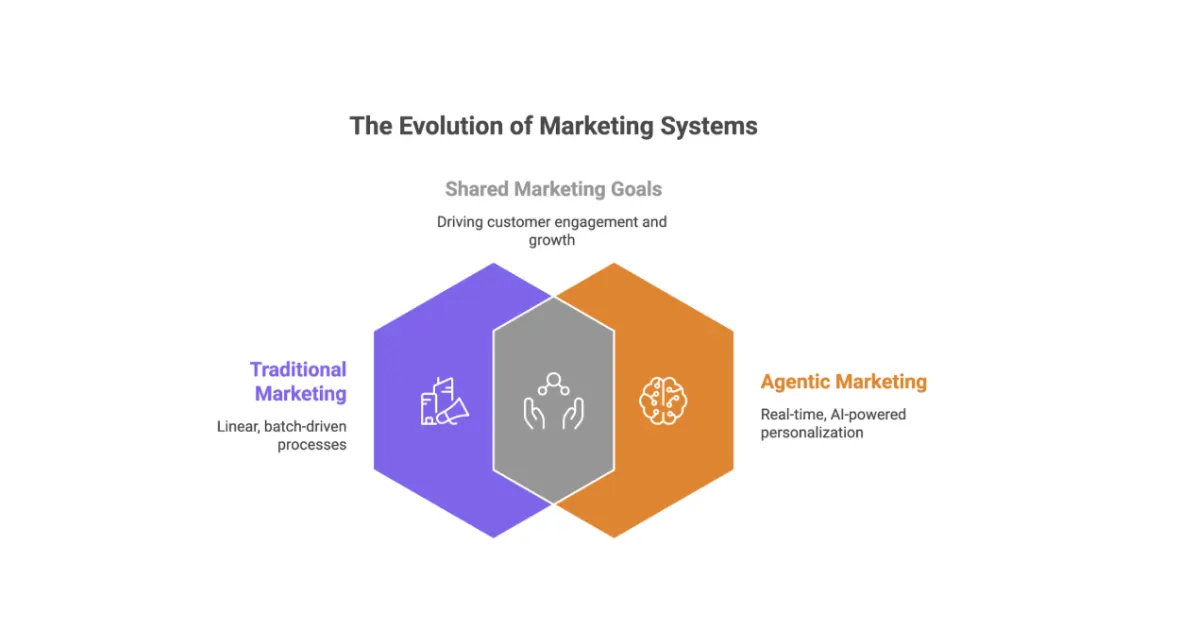
Most B2B marketing teams are still operating with systems designed for a different era. Campaign calendars, batch sends, and static journeys were built for a world where data was limited and execution was slow. That world no longer exists.
Today, customer signals are continuous. Product usage, web behavior, and engagement data are generated in real time. At the same time, AI has removed many of the constraints around execution. It is now possible to act instantly, at scale.
In this environment, running the same campaigns faster does not create advantage. It simply scales outdated strategies.
What breaks is not just the tooling, but the underlying model of how marketing operates.
The Shift from Campaigns to Systems
To compete in the agentic era, marketing teams need to move beyond campaign-centric thinking. The goal is no longer to plan and execute a sequence of messages. It is to build a system that continuously adapts to the customer.
This requires a different foundation.
First, teams need a unified and real-time view of the customer. Data cannot live in silos across product, sales, and marketing systems. It needs to be connected and continuously updated so that every decision is based on current context.
Second, systems need to be able to make decisions, not just execute instructions. Instead of relying on predefined workflows, they must be able to interpret signals and determine the next best action dynamically.
Finally, execution needs to be immediate and contextual. Customer experience is no longer defined by campaign timing, but by relevance. The ability to respond at the right moment, with the right message, based on actual behavior, becomes a key differentiator.
This is the shift from marketing automation to agentic marketing.
Marketing Teams Need to Build For
- Data readiness : A modern data foundation that unifies customer signals across product, sales, web, and marketing systems.
- Context orchestration: A shared understanding of customer state that agents and teams can use consistently across functions.
- Open activation: An architecture that allows AI agents, workflows, and human operators to coordinate actions across channels and systems.
- Journey optimization: The ability to continuously improve customer experiences based on live behavior, intent shifts, and value realization.
- 1:1 customer engagement: Communications and experiences that reflect the customer’s real context, rather than static segments or fixed cadences.
This is the strategic shift from marketing automation to agentic marketing.
The New Moat for B2B Growth
For years, B2B companies built competitive advantage through product features, workflow depth, and operational scale. Those factors still matter, but their durability is changing.
AI is making software easier to build and faster to replicate. As a result, feature-based differentiation is becoming less sustainable. At the same time, access to AI capabilities is becoming more uniform across companies.
The new moat is harder to copy.
It comes from proprietary customer data, systems that can reason across that data, and the ability to activate experiences in real time. It is reinforced by customer relationships that are built through consistently relevant and valuable interactions.
In this context, growth is no longer driven by campaigns alone. It is driven by the quality of the system that connects data, intelligence, and execution.
Final Takeaway
AI does not create competitive advantage on its own. The models are widely accessible, and their capabilities are increasingly similar. What matters is what you build around them. The companies that win in the agentic era will not be the ones that use AI to do the same marketing faster. They will be the ones that redesign their go-to-market systems to turn customer context into action, continuously, and in real time. That is how AI moves from an efficiency layer to a true driver of growth.
Inflection helps B2B and AI-native companies drive pipeline and growth across the account lifecycle. By unifying data through the ContextGraphTM, Inflection powers demand generation, onboarding, and expansion with the intelligence and automation teams need to deliver measurable impact. Request a demo today.
