Inflection Introduces Streaming Salesforce Sync for Real-Time Marketing
We are excited to announce a foundational upgrade to Inflection’s Salesforce sync. Built on Apache Flink, our sync now uses real-time stream processing to deliver continuous, high-throughput data flow. This isn't a patch on a legacy model; it is a new architectural foundation that eliminates the "nightly sync" workarounds GTM teams have endured for decades.
 A Step Change in Sync Performance
Inflection has been datawarehouse native since the beginning, handling orders of magnitude more data than legacy MAP. This meant that we have always delivered a much higher throughput better Salesforce integration than legacy marketing automation systems. The move to Flink represents a massive leap, and Inflection customers are already seeing the difference.
In production syncs across many different customers, Inflection has processed nearly 16.5 million records per hour whereas Marketo's Salesforce sync processes only 18,000 updates per hour in real-world conditions. That’s nearly 900x higher throughput.
Inflection was already faster than legacy systems. Syncs that took days in Marketo were reduced to hours. With this upgrade, that performance advanced even further.
Now, as data volume increases, sync performance keeps pace. Larger datasets do not automatically mean longer wait times. The system processes more data within the same window, making sync feel continuous instead of delayed.
This is the difference between a system that slows down as you scale and one that keeps up with you. And that difference is exactly what most GTM teams have been missing.
When Salesforce Sync Holds Back GTM Velocity
If you have worked in MOPs, marketing, or sales with Marketo and Salesforce, the pain is familiar. This is one of the core reasons teams start evaluating a Marketo alternative.
You update Salesforce. A campaign depends on it. Then you wait. The sync is behind. Triggers lag. Teams adjust by pushing syncs to off-hours, limiting real-time workflows, and designing campaigns around stale data.
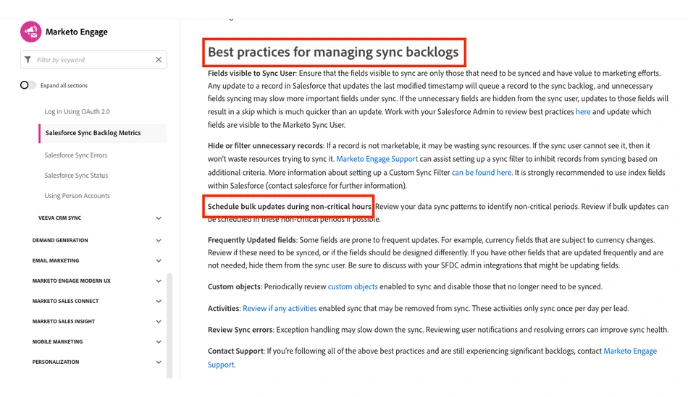
Over time, this becomes normalized. Sync speed quietly dictates how fast GTM can operate. Marketo itself recommends scheduling large updates, merges, and sync-heavy operations during non-business hours to avoid overwhelming the system and creating backlogs.
 Why This Happens in Legacy Systems
Marketo is a platform where multiple customers (tenants) share a single common MySQL instance. Many customers or tenants are assigned to the same processing environment. Within that environment, Salesforce sync, smart lists, trigger campaigns, and email sends all compete for the same finite processing capacity. This creates what MOPs experience as the “noisy neighbor” problem:
If another customer in the same environment runs a heavy sync or large batch job, your sync slows down.
If your own Salesforce sync grows large, it consumes processing capacity needed for triggers and sends.
The platform prioritizes stability over freshness, which means sync backlogs accumulate.
Marketo’s answer to this has been “dedicated pods”, offering a form of isolation for a massive additional cost. But this does not change the underlying model. At best, you move to one company on one MySQL instance, where all workloads still compete for the same limited resources. Large sync jobs continue to impact execution, and performance remains constrained.
This is why Salesforce sync becomes an operational bottleneck. It is not just about integration, but about an architecture that cannot scale cleanly under real-world load.
The Inflection Difference
Inflection, the marketing automation platform built for the AI era, approaches Salesforce sync from a completely different architectural stand point. This is not a feature upgrade layered on top of an existing system. It is a model that removes the constraints legacy platforms are built around.
Dedicated, Elastic Compute Per Tenant
Instead of sharing a single database instance across many customers, Inflection allocates horizontal compute at the tenant level. Conceptually, this looks like 32 machines for one company, not 32 companies on one machine. This elasticity is baked into the platform without extra add-ons.
Streaming Vs. Batch Processing
With the introduction of Apache Flink, Salesforce change events are processed continuously through an elastic streaming pipeline rather than queued into large, resource-hungry batch jobs. Large sync volumes no longer monopolize system resources.
This shift reflects a broader difference in how the system is designed. Legacy platforms like Marketo were built around batch processing and shared capacity for an earlier generation of marketing workflows. Inflection is built around continuous data movement and elastic scaling, needed for modern companies today.
The result is a system where Salesforce sync remains fast and reliable as data grows, without requiring teams to plan around it or make tradeoffs elsewhere in their workflows.
Salesforce Sync That Keeps Up With Your GTM Motion
Salesforce sync should not dictate how fast your marketing campaigns can operate. With streaming architecture and elastic compute, it becomes something you can rely on instead of work around. Data moves continuously, campaigns stay real-time, and execution no longer slows down as you scale.
Inflection is designed for companies that want marketing to drive pipeline, product adoption, and expansion without operational bottlenecks. If legacy marketing automation has already slowed you down, request a demo to see how Inflection changes that.