Best Marketing Automation Platforms for DevTools Companies

DevTools companies face a marketing challenge that most traditional B2B teams never encounter: the product is the first touchpoint, the evaluation cycle happens inside the product, and the buyer is often an engineering team that never fills out a form. Evaluation happens inside the product, not through forms or gated content. Activation is a developer getting hands-on with the product. Adoption is measured through how deeply teams use the product over time. And revenue depends on aligning that technical behavior with a multi-person engineering and procurement cycle.
Most marketing automation platforms were never built for this scale. They can't handle product usage at scale, can't model accounts or buying committees, and can't trigger revenue workflows from product behavior. DevTools teams end up forcing technical motions into tools designed for ecommerce or generic lead nurturing.
Understanding that gap is the only way to evaluate which platforms actually work for a developer-first, product-led GTM model.
What Modern DevTools Marketing Requires
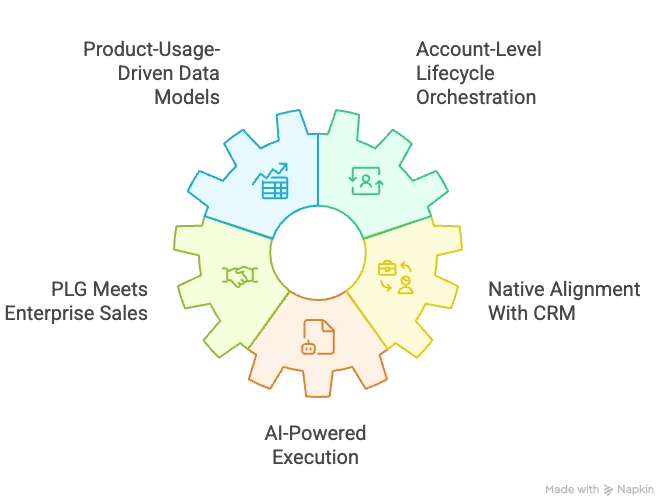
Product-Usage-Driven Data Models
Developer activation is driven by concrete product actions: getting access, connecting tools, trying features, running workflows, and shipping to production. A DevTools GTM motion generates continuous signals about how teams are engaging with the product long before a salesperson is involved. Any platform that can’t capture, interpret, and act on high-volume product usage data breaks at the foundation.
Account-Level Lifecycle Orchestration
DevTools adoption never happens at the individual level. A single evaluation may involve multiple engineers, a technical lead, platform or DevOps teams, security, and procurement. A marketing system tied to a single “lead” or “contact” cannot represent how DevTools are actually evaluated, approved, or expanded.
PLG Meets Enterprise Sales
Self-serve may drive initial usage, but enterprise revenue comes from orchestrating both:
product behavior (activation, depth of usage, production deploys)
human behavior (sales follow-up, multi-threaded engagement, deal progression)
Tools built for consumer loops or simple email journeys break when faced with long, multi-threaded evaluations that span teams and months.
Native Alignment With CRM
Pipeline stages, opportunities, account ownership, expansion readiness, and renewal risk must define lifecycle automation. When marketing operates outside CRM context, usage insights stay disconnected from revenue action and sales loses visibility into real product momentum.
Consumer-first systems were never designed for this. Legacy marketing automation predates PLG entirely. That leaves a narrow set of platforms capable of supporting real DevTools GTM.
AI-Powered Execution
DevTools marketing operates in an environment where conditions change constantly, which is why AI-native marketing is becoming the execution model rather than an emerging trend.
Product usage evolves daily, accounts move at different velocities, and buying groups expand as adoption spreads. Manual, rule-driven lifecycle programs cannot keep up with this pace. DevTools marketing teams require systems where AI is responsible for translating intent into execution across product usage, account context, and revenue signals.
Rather than defining every segment and workflow in advance, marketers define outcomes and allow AI to continuously generate and adapt execution as inputs change. This shifts lifecycle marketing from static configuration to adaptive orchestration. It is no longer an optimization or future consideration. It is the execution model DevTool marketing teams need to operate effectively today and the foundation required to scale as products, data, and GTM complexity continue to increase.
The Contenders: Marketo vs. HubSpot vs. Customer.io vs. Inflection
Adobe Marketo
Marketo is still widely perceived as the enterprise default, which is why many DevTools companies inherit it as they move upmarket. In practice, that legacy positioning often creates more friction than alignment. Marketo was designed for a different era of B2B marketing, one built around batch campaigns, low-frequency signals, and rigid operational processes. When DevTool marketing teams attempt to layer modern, product-led motions on top of it, the system quickly becomes a bottleneck rather than an enabler.
Operationally, Marketo is prone to performance slowdowns, sync delays, and complex failure states that impact both marketing execution and sales visibility. Marketers can’t iterate quickly, while sales teams experience lagging or inconsistent signals in CRM. As product usage data is introduced, Marketo’s architecture forces teams into fragile workarounds, aggressive data throttling, or expensive middleware just to approximate real-time insight.
For DevTools companies that are AI-native or running product-led motions, this creates a clear need for a Marketo alternative, one that can support modern usage-driven GTM without sacrificing sales alignment.
HubSpot
HubSpot is the default starting point for many SMB companies because it centralizes CRM and marketing in an approachable interface. That simplicity works early, but it becomes a constraint as DevTools products generate richer usage signals and more complex lifecycle states.
HubSpot struggles to utilize nuanced, behavior-based logic across time, teams, and accounts. As marketers attempt to layer product usage into campaigns, workflows become brittle and costs escalate quickly. HubSpot remains effective for basic inbound and content-driven motions, but it strains under the demands of marketing a DevTool.
Customer.io
Customer.io was built for B2C–consumer and transactional use cases where the goal is to react instantly to individual user behavior. That architecture makes it appealing to DevTools teams early on: it’s fast, flexible, and highly responsive to in-product actions. For onboarding emails, usage nudges, and real-time notifications, it performs exactly as designed.
The limitation appears when DevTools companies try to run a full B2B lifecycle. Revenue is driven by team-level adoption, account context, and sales coordination—not isolated user actions. Customer.io does not model accounts, pipeline, or buying groups, which turns it into a messaging layer rather than a lifecycle system. Marketing sees activity; sales does not. The tool cannot orchestrate how DevTools companies actually grow.
Inflection.io
Inflection is the only platform in this comparison whose architecture directly matches how DevTools companies grow: usage drives activation, activation qualifies accounts, accounts drive pipeline, pipeline converts into enterprise revenue.
Why Inflection for DevTool Marketing
Inflection is designed for product-led, AI-native DevTools environments from the ground up. It supports continuous product usage data without artificial limits, models both users and accounts as first-class entities, and runs lifecycle programs across onboarding, activation, qualification, expansion, and renewal as one system. Native, bi-directional CRM integration keeps account ownership, opportunity state, and pipeline context tied to the same signals marketing uses, so revenue workflows trigger from what is happening in the product and in the deal, not from disconnected engagement metrics.
Inflection has moved miles ahead with AI at the core of the operating model, not a feature. The platform is built to let teams create and run campaigns wherever they work, including directly in the product and inside Slack, with campaign creation shifting from “build the workflow” to “state the goal and generate the program.” That is reinforced by a Slack-based campaign operations agent that can build campaigns from a Slack request, and by the Marketing MCP server which exposes Inflection context to AI assistants so they can draft campaigns, journeys, and analysis using real lifecycle data. For teams that want cross-platform execution, Inflection also supports agentic marketing automation workflows using n8n, so lifecycle work can extend beyond a single UI into orchestrated operations across tools.
Inflection bridges the gap DevTools marketers experience with legacy marketing automation. The result is a lifecycle marketing platform that understands both product usage and enterprise revenue mechanics, without forcing teams to choose between flexibility and alignment.
Why DevTools Marketing Requires a Different System
DevTools marketing has crossed a threshold. The combination of product-led adoption, multi-threaded buying cycles, and continuous product usage has made legacy marketing automation structurally insufficient. Systems built for leads, campaigns, and static workflows cannot keep pace with how DevTools companies actually grow or how modern marketing teams are expected to operate.
The platforms that succeed in this environment are the ones that treat product usage, account context, purchase intent, and execution speed as a single, unified problem. This is where Inflection stands apart. Its architecture is purpose-built for DevTools GTM, unifying product behavior, account-level lifecycle orchestration, CRM context, and AI-driven execution into one system. Instead of forcing teams to stitch together engagement tools, data pipelines, and legacy automation, Inflection allows marketing and sales to operate from the same signals in real time.
As DevTools products become more complex and expectations for speed and precision continue to rise, the gap between legacy automation and platforms built for this reality will only widen. Inflection is designed for that future. For teams running product-led, AI-native DevTools businesses, it is the platform built to sustain growth rather than slow it down.
Request a demo to see how Inflection supports modern DevTool marketing from activation through expansion revenue.