What Marketing Operations Needs to Know About MCP Servers
MCP servers have the potential to transform marketing, and marketing ops orgs are poised to lead the charge. However, MCP servers are so new that when I looked to learn more, I could barely find any information. And certainly not how it applies to B2B marketing. I spent many hours diving in, and this blog post summarizes my learnings.
MCP is a new infrastructure layer emerging at the center of AI, and it will become as foundational as APIs. I’m incredibly excited about the functionality you get with MCP servers today and their long-term potential for being a core part of B2B marketing.
What is MCP?
MCP stands for Model Context Protocol. Anthropic, the company behind Claude, introduced this open protocol. MCP defines a shared standard for AI to interact with external tools. It’s a connective layer that gives LLMs structured, predictable access to the data and tools that power your business. It’s been such a powerful addition to so many teams that AI companies like OpenAI and automation tools like n8n are now supporting MCP servers as well.
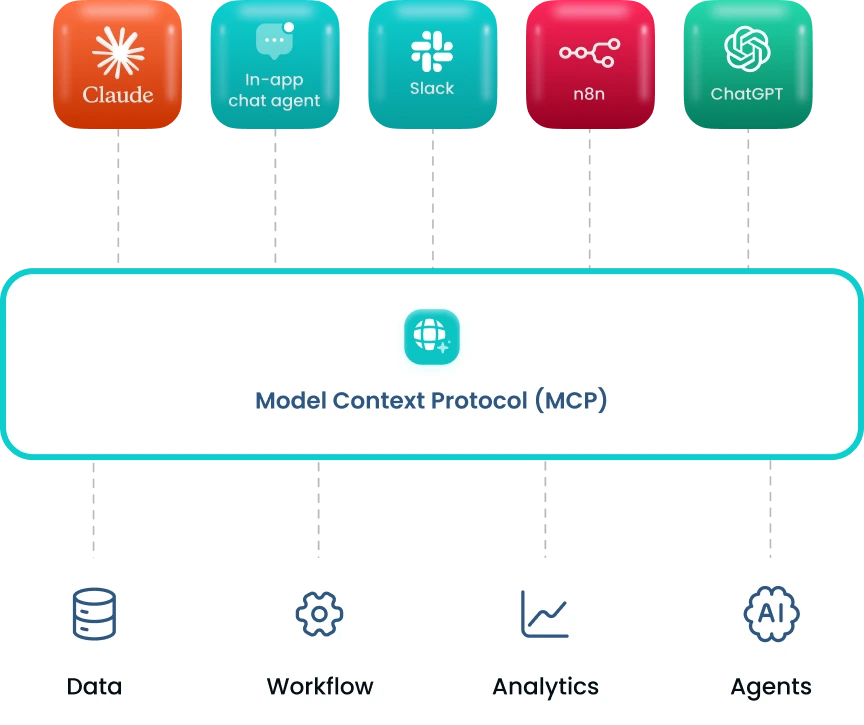
Before I talk about capabilities, let’s talk about MCP and your data. One of the most popular use cases for MCP servers is “chatting with your data.” This is not even close to the most impactful use case, but let’s start here!
Chatting With Your Data
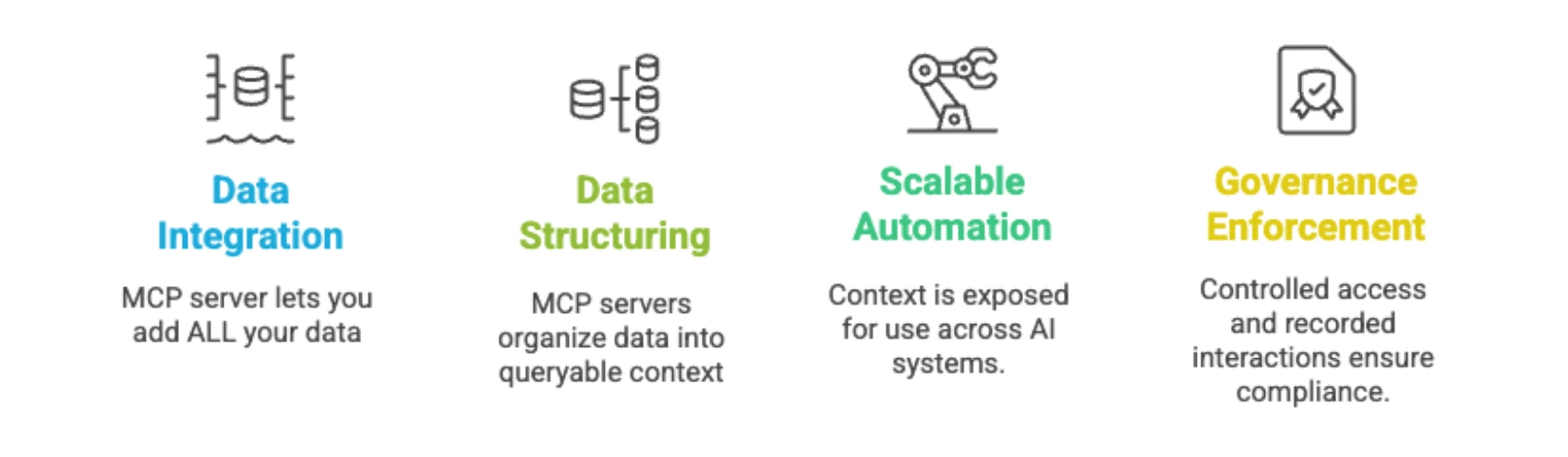
MCP servers allow vast amounts of data to be shared with LLMs. Today, connecting an AI system to your marketing tools would mean storing your data somewhere portable and stitching together APIs to each AI platform you want to use (Claude, ChatGPT, etc). That is more work than a full-time engineer could reasonably develop and manage. With an MCP server, it’s all done for you. Instead of manually connecting individual data sources to each AI platform, just connect the MCP server to each platform, no APIs required.
Not Just Analyze But Execute
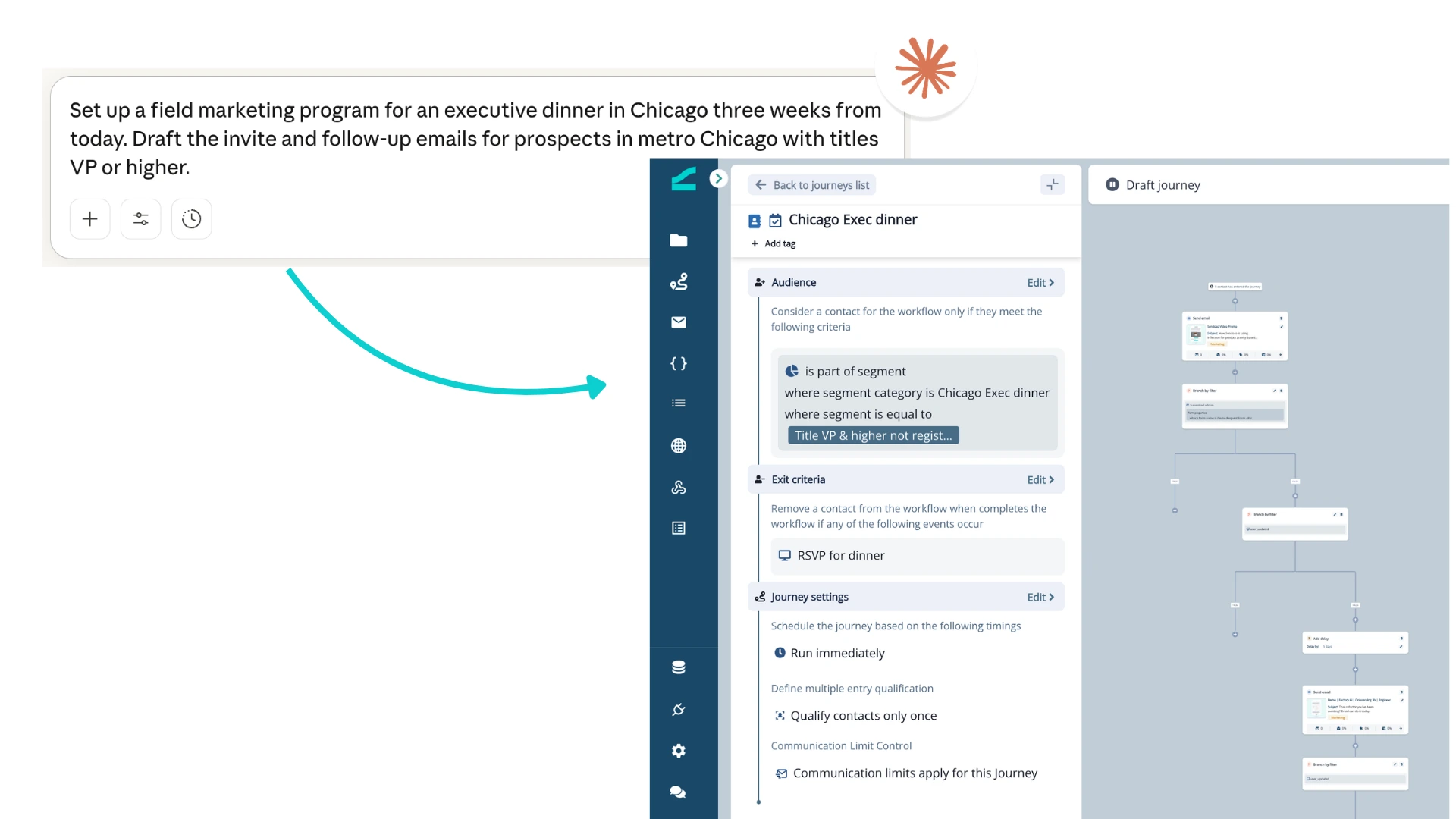
MCP servers can be much more than a better way to do reporting within Claude or ChatGPT. They also have the potential to interact with your app like a human would. Not all companies build their MCP this way, but that is how we built ours at Inflection. Our customers can use Claude, ChatGPT, and even Slack etc., to actually build marketing campaigns – journeys, emails, and audiences from just a prompt.
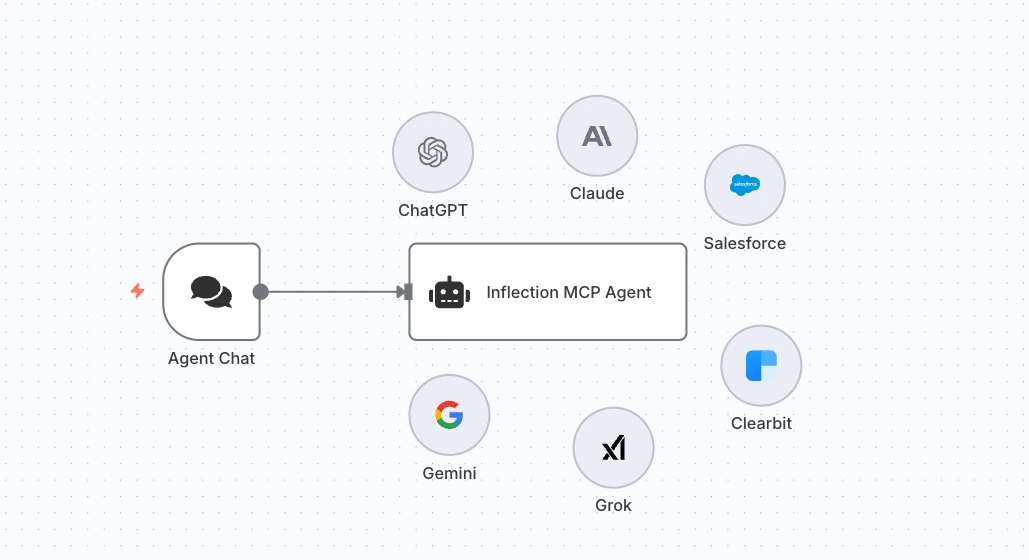
MCP servers can also be part of workflows. For example, workflow automation platforms like n8n are supporting MCP servers. You can imagine a workflow for a new lead that comes into Salesforce, is researched by an AI agent, is enriched by another agent, then has a personalized email created for them and sent from within Inflection.
Human-In-The-Loop
Another great aspect of MCP servers is governance. It creates a controlled boundary between AI and your data. Marketing operations can define exactly what the system is allowed to see and what actions it can take. It records every interaction, which is critical for compliance, auditing, and trust.
Why MCP Matters For Marketing Operations?
MCP centralizes the work MOPS have been responsible for–integrations, data access, governance, and execution into an AI-ready layer. It removes the operational bottlenecks that force every request through MOPs and instead lets agents execute while MOPs control the rules, access, and context. This is what enables these examples.
Integrate Once
As already mentioned, MCP servers allow marketing teams to integrate once. For example, instead of connecting APIs from each application into Claude or ChatGPT, marketing ops can simply enable the MCP server. This can save hundreds of hours of work on the initial integration and maintenance. A new, better competitor to ChatGPT and Claude just started? Great, just enable the MCP server, and you are up and running with agentic capabilities.
Eliminate Jira Hell
Most of the time, marketing operations is the user of marketing tools. Often, this is because the marketing systems require specialized knowledge on how to use them properly. We see this a lot with legacy marketing automation tools like Marketo. With an MCP server, agents can use the tools, allowing any marketing team member to be a user, eliminating the need for back-and-forth between teams and marketing operations.
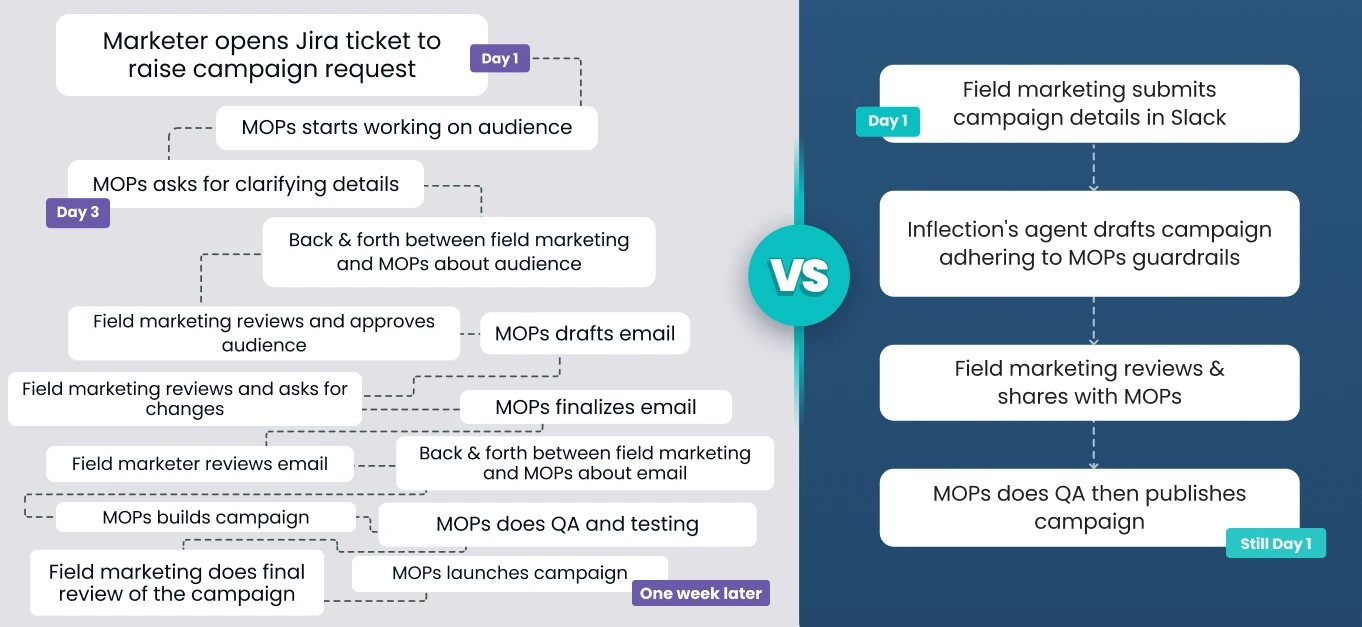
Let me give you an example. For many field marketers, launching events typically means opening tickets with Ops, waiting for audience lists, reviewing messaging with stakeholders, and managing multiple approval cycles before anything can launch. When teams are running dozens of events each quarter, that manual coordination becomes the bottleneck. With Inflection, campaign creation is democratized. Field teams can have AI draft their campaign with Ops teams reviewing, and launch much faster.
I used the following prompt: “We’re hosting an executive dinner in San Francisco to engage senior GTM leaders. Set up a field marketing plan starting with building an audience segment of VP-level and above prospects in the San Francisco and Bay Area who fit our ICP and have shown recent engagement. Also, build the campaign.”
Save Time On Reporting And Analyzing Campaigns
Reporting out on a single campaign isn’t too big of an ask. But what if you want to report over time or across multiple campaigns? Or more in depth, provide analysis for how campaign performance has been changing over time. It’s not uncommon for these types of requests to take days of effort. With an MCP server, they can be done in just a few minutes.
Here’s an example. I used the prompt: “Analyze our lead nurturing campaign and provide recommendations on how to improve performance. Specifically, I want to increase the clicks to our demo request page from this campaign.”
With the MCP server connected to the webinar platform, CRM, and marketing automation, the system aggregates attendance, engagement, and pipeline data. Then summarize what worked, what didn’t, and what to change. MOPs doesn’t have to build reports or run exports — the analysis is automated through structured context.
What If My MarTech Doesn’t Offer An MCP Server?
Many legacy providers don’t offer an MCP for their customers. It could be because they are just slow to innovate or because they don’t want customers to be able to access app data or rebuild workflows in other applications. Either way, sometimes you can still be covered.
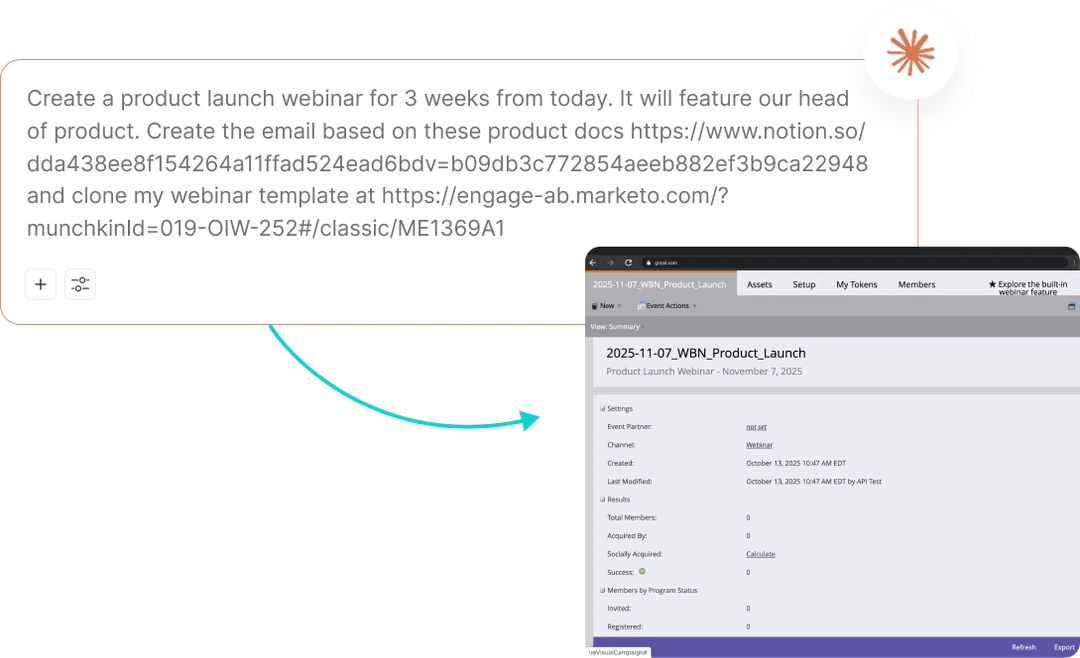
For example, Marketo doesn’t offer an MCP server, so we built a free and open-source Marketo MCP server that you can use.
It’s full featured, allowing you to “chat with your data” such as analyze webinar programs, create campaigns from a prompt, or even reduce effort for incoming requests from sales such as quickly answering “Why did this lead MQL?” or “Why didn’t this lead MQL?”
How Should I Evaluate MCP Servers?
All MCP servers are not created equal. Some allow you to just chat with your data, while others offer agentic capabilities.
When evaluating new marketing technologies, here are 3 questions you can ask vendors to assess their MCP capabilities.
Does it make data available to LLMs or just partial data? Some apps only allow their MCP server to access partial data, limiting the context and reporting capabilities of their MCP server.
Is the MCP reporting only, or does it have write capabilities? Some apps only allow their MCP server to serve reporting scenarios, and don’t allow the MCP server to have agentic capabilities. For example, they don’t allow it to create campaigns in marketing operations.
Is it closed, meaning you can only use it in the app, or open allowing you to use it where you work? Some apps only allow their MCP server to operate within their app. They don’t allow apps like n8n to access the MCP server.
When evaluating marketing technology ideally they have an MCP server and all 3 are true.
MCP Servers Are Going To Kill “MarTech Stacks”
We are not far away from many MarTech apps providing an MCP server. Most of this article has covered working with a single MCP server, but there is extreme benefit in having multiple MCP servers work together.
For example, if you have a marketing technology that doesn’t integrate with another tool you use, but both have an MCP server… poof they now can talk and work together without writing any code (as long as they both provide agentic capabilities. No heavy integration work, no APIs.
The workflow capabilities in this future are almost difficult to comprehend. Some of your marketing may be able to become autonomous and handled on a recurring basis just by a single ask (prompt).
The $500k Marketing Operations Teammate
MCP servers and agentic marketing represented a huge shift in marketing and marketing operations. It’s highly technical and requires dedicated resources to support. Perfect for marketing operations to own.
MOPs teams are FULL of experts at wrangling data and tools and making it useful to the organization. We will soon see marketing operations teams add “MCP server ownership” and “context engineering” to job descriptions.
I think we will also see marketing operations team members get to $500K/year. CMOs are being peppered by the CEO and board to answer “how is marketing using AI” and “where’s the efficiency in marketing for using AI”? The answer to both will be provided by a marketing operations team member who spearheads this work.
Why This Moment Matters
Right now, only about a quarter of marketing operations professionals have even heard of MCP, and most don’t understand what it is. That will not stay true for long. As GTM teams push toward AI-native marketing automation, MCP will shift from an edge concept to a baseline requirement.
The teams that adopt it early will move faster, automate more intelligently, and build autonomous workflows that scale. MCP is not a nice-to-have. It is the foundational layer that will determine how effectively your organization uses AI across marketing.
For marketing operations, understanding MCP is no longer optional. It is how you prepare your team, your systems, and your strategy for the next era of marketing, one where intelligence does not just generate content but drives growth.
Inflection built the connective layer that will define marketing in the AI era. With ContextGraphTM at its core, our MCP server transforms raw data into structured, actionable context and enables systems that not only generate content but drive growth. Request a demo today to see it live.