
%201.webp)

How Fivetran Built a Self-Serve Flywheel on Top of Sales: Lessons from the Trenches
PLGTM Summit is now Demand & Expand 2026, a bigger, bolder two-day event built for the full spectrum of B2B marketers. Join us May 19–20, 2026 in San Francisco.
Think of product-led growth (PLG) and sales-led growth like two engines on a plane: powerful on their own, but unstoppable together. Jess Tillis, Director of PLG Revenue at Fivetran, showed how combining self-serve velocity with strategic sales support created a new revenue flywheel—without burning out either engine.
This article recaps Jess’s PLGTM 2025 session. Click 👇 to watch the full session.
Setting the Stage: From All-In Sales to Hybrid Growth
Picture Fivetran in 2022: a purely sales-led motion humming along, driven by a strong revenue operations backbone. Despite having a 14-day free trial and the ability to buy with a credit card since 2020, they still insisted on calling every single lead. The free trial was more of a marketing checkbox than a true conversion path.
Then came the million-dollar question: Would small companies buy without a rep breathing down their neck?
To find out, they ran a year-long experiment in 2023, splitting sub-200 employee leads between classic sales and pure self-serve. The hypothesis: small customers would convert at similar rates, rep or no rep.
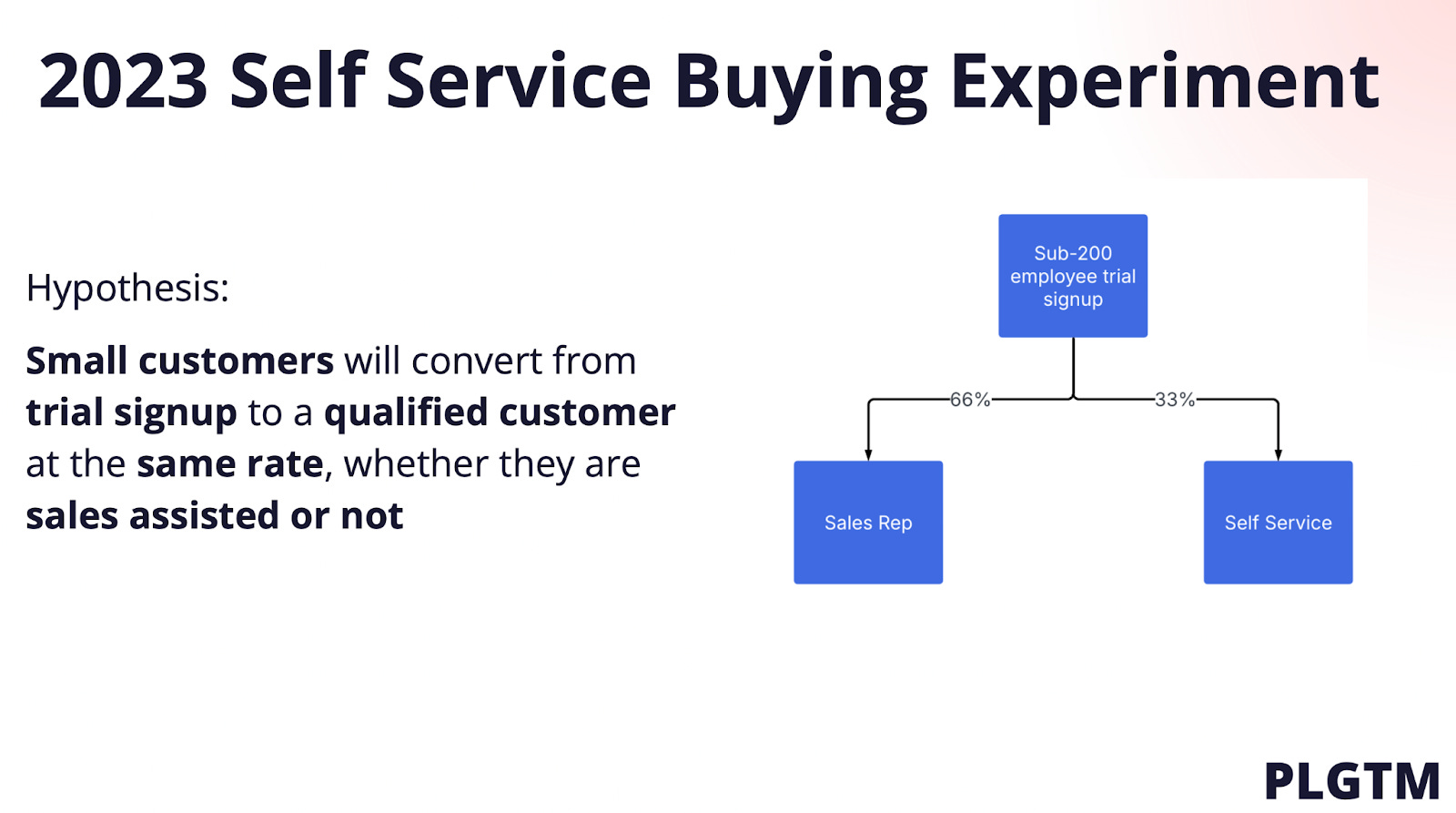
The result? Conversion rates were basically the same. Average revenue per customer was higher when a salesperson was involved—but not enough to justify tying up expensive reps. That was the green light to scale self-service.
The Self-Service Machine: Happy Paths and “Minnows”
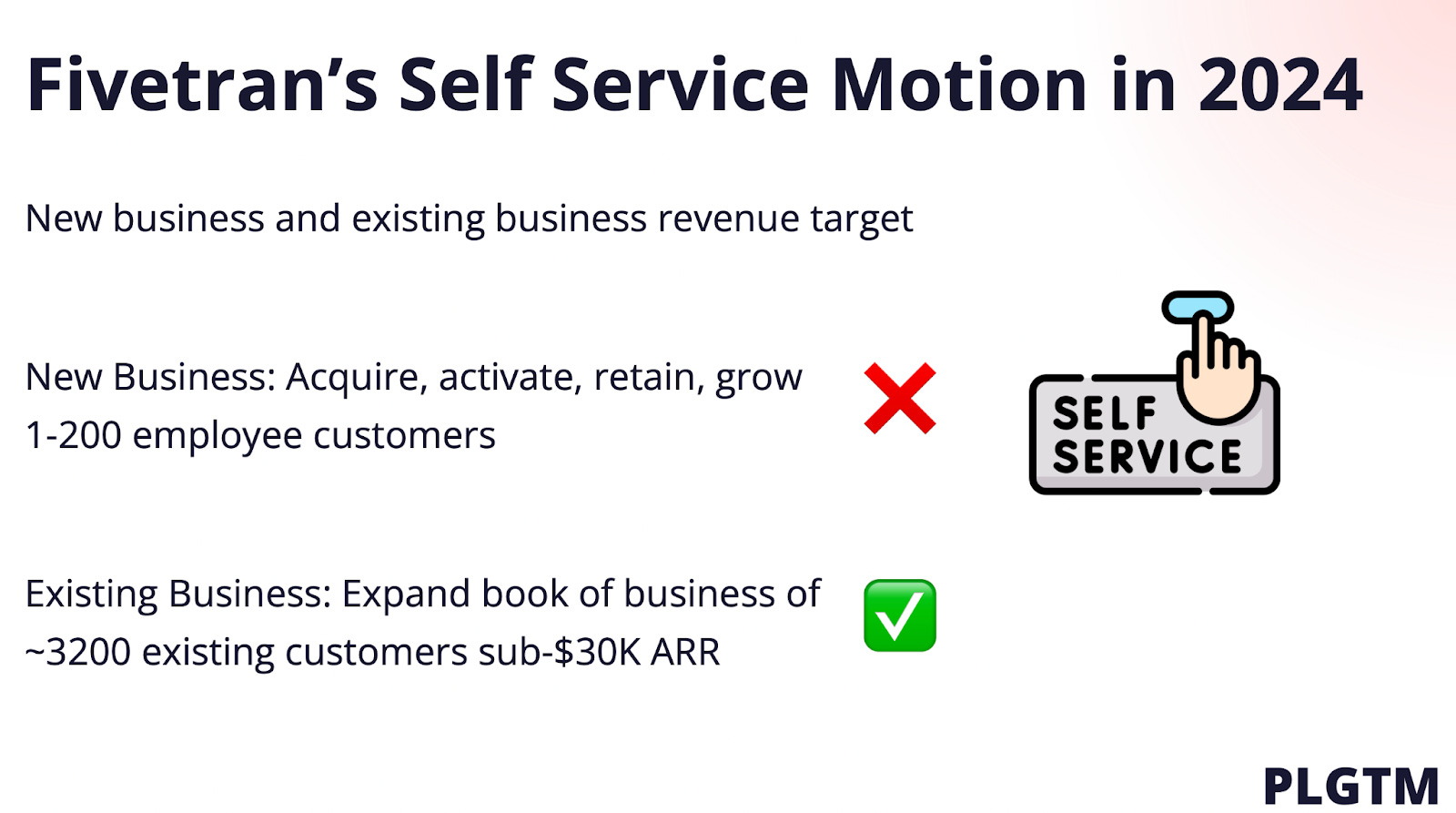
With the new motion launched in 2024, the goal was twofold: acquire and retain small customers via self-service and expand existing accounts. But early data showed that while “no touch” self-service customers were rolling in, the numbers weren’t climbing fast enough to hit ambitious new targets.
The team realized they needed to improve two things:
- The self-serve user journey (so more users could succeed solo).
- The effectiveness of product success managers (PSMs) for those who needed help.
Before retooling, PSMs were like fishermen casting nets for big trout (high-value leads to pass to sales), sometimes scooping up a few minnows (small accounts). After shifting strategy, they recast their nets to catch entire schools of minnows—smaller customers who just needed gentle nudges to convert. This new focus helped them “unstick” customers without scaring them off with unwanted sales calls.
The Product Trigger Framework: Knowing When to Jump In
A big part of Fivetran’s secret sauce was product triggers—behavioral signals that revealed when a customer might be stuck or primed to buy.
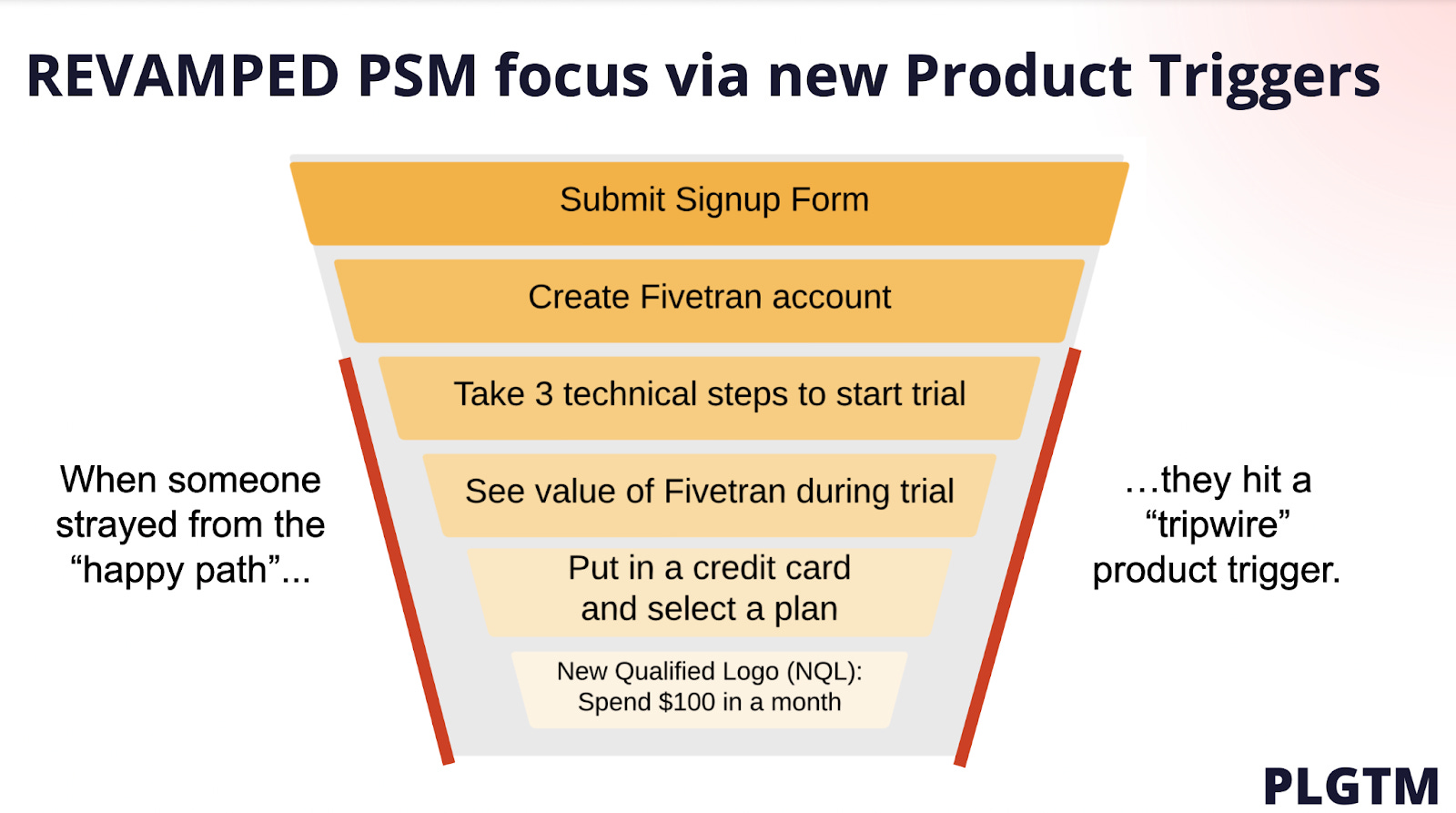
Before, triggers focused on high-value signals (like big budget estimates), meant to escalate users to sales. But the revamped approach layered in “tripwire” triggers—signals showing a user had strayed from the “happy path” (for example, starting a trial but stalling before final steps).
By intervening only when users actually needed help, PSMs avoided cannibalizing the self-service flow and instead layered incremental wins on top.
A few practical takeaways from this approach:
- Map the happy path carefully. Identify where customers typically succeed and when they drop off.
- Introduce triggers for stuck moments. Reach out just in time, not too early.
- Shift team incentives. Change quotas to focus on helping customers, not just generating pipeline for sales.
The Results: A New Revenue Engine
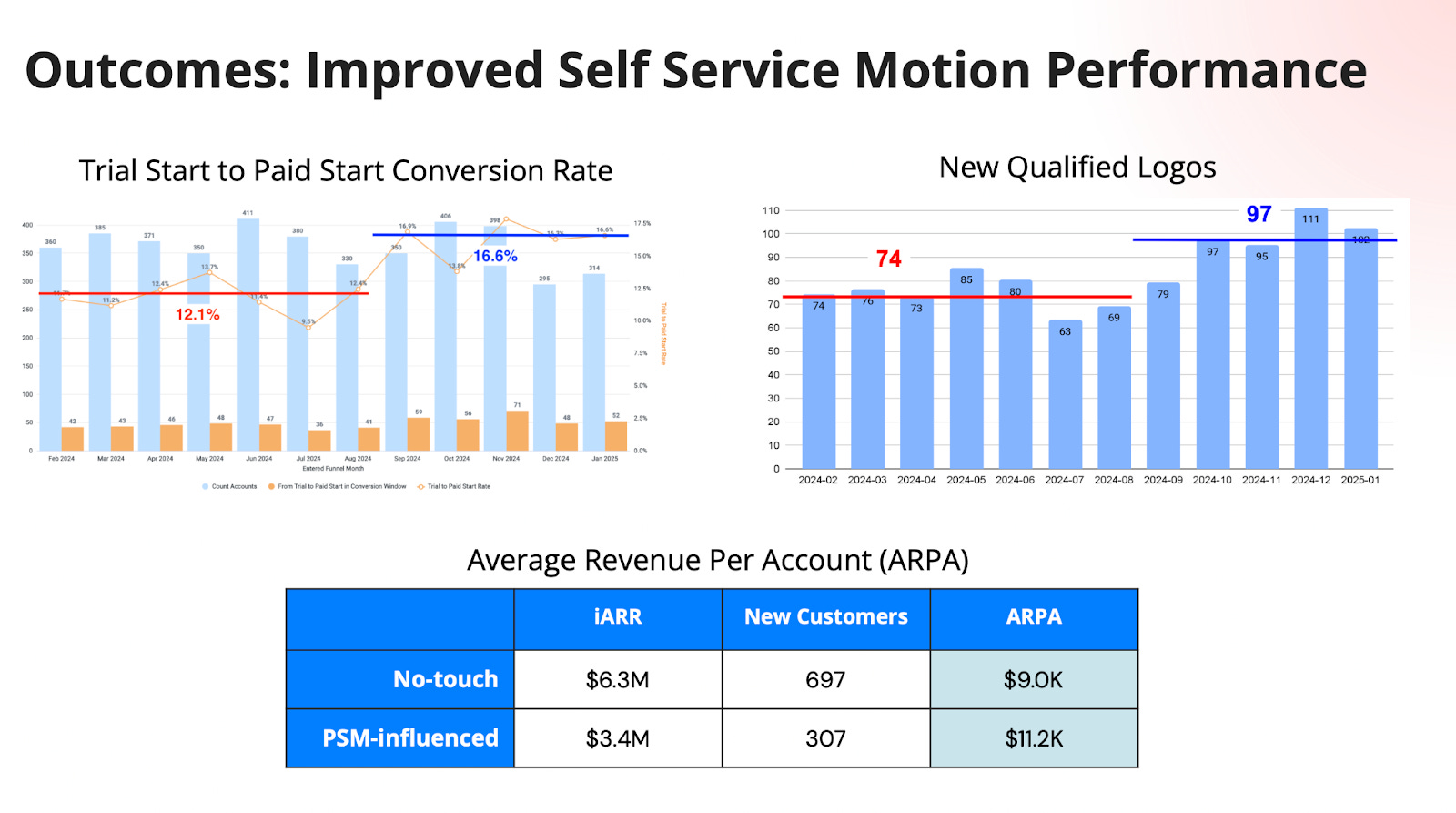
Once the new product triggers and refined PSM strategy were in place, the impact was immediate and measurable.
Rather than disrupting the no-touch self-service base—which continued delivering around 60 new customers per month—the team layered on PSM-influenced conversions to boost the overall numbers. Trial-to-paid conversion rates jumped to 16.6%, and average new qualified logos per month climbed to 97.
Notably, this approach didn’t sacrifice efficiency: the average revenue per account remained healthy, and self-service ARR even outpaced PSM-influenced ARR in some cases. The goal was never to “force” every user into a high-touch motion but to guide them just enough to succeed.
By the end of the year, Fivetran’s hybrid motion was driving 22% of incremental revenue—and they were on track to hit 147% of their new business target in Q1.
What’s Next: Expanding the Expansion
While new business is cruising, the speaker shared that Fivetran’s next frontier is existing customer expansion. Last year, they coasted on organic expansion; this year, it’s a deliberate priority.
Fivetran’s journey is a reminder that hybrid GTM motions aren’t just bolt-ons—they’re dynamic systems that require continuous tweaking and brave experiments.
